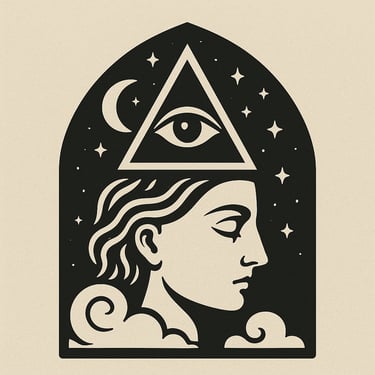
The Disturbance of the Logos
"When it appeared, I mean, the Logos, who is in the heart of those who pronounce it - it was not merely a sound but it has become a body - a great disturbance occurred among the dishes, for some were emptied, others filled: some were provided for, others were removed; some were purified, still others were broken. All the spaces were shaken and disturbed for they had no composure nor stability. Error was disturbed not knowing what it should do. It was troubled; it lamented, it was beside itself because it did not know anything.” The Gospel of Truth
Alan Dyer
9/26/20252 min read


The Disturbance of the Logos:A Reflection from the Gospel of Truth
When the Logos Appeared
“When it appeared, I mean, the Logos, who is in the heart of those who pronounce it, it was not merely a sound, but it has become a body. A great disturbance occurred among the dishes: for some were emptied, others filled; some were provided for, others removed; some were purified, still others were broken. All the spaces were shaken and disturbed, for they had no composure nor stability. Error was disturbed, not knowing what it should do. It was troubled; it lamented, it was beside itself because it did not know anything.” The Gospel of Truth
This is the teaching of the Word that became a body (John 1:14). Not a doctrine, but a disturbance.
Not a sound, but a shaking.
Not a whisper, but a quake (Hebrews 12:26–27).
When the Logos appeared, the dishes were overturned. Some were emptied, others filled. Some were purified, others broken. This is not chaos, it is consecration. For the Logos does not arrive politely. It arrives as truth, and truth is the mouth of the Father (John 14:6).
On the Tongue of the Spirit
The Holy Spirit is not only symbolized as a dove. It is the tongue of the Father, joining Him to truth, attaching Him to the mouth at the moment of utterance (Acts 2:3–4).
To receive the Spirit is to be spoken.
To be spoken is to be known (1 Corinthians 13:12).
When the Spirit utters, we are no longer echoes of ourselves, we are words in the Father’s own sentence.
On the Spaces and the Names
“All spaces are His emanations.” They stem from Him as children from a perfect man (Acts 17:28). But they do not know Him until they are given form. They do not know Him until they are given name.
The Father knows every space within Himself. He reveals whom He desires, not by command, but by naming (Isaiah 43:1).
To be named is to come into being (Genesis 2:19–20).
To be unnamed is to remain in sleep (Ephesians 5:14).
On the Shadows and the Morning
Those who do not yet exist are not nothing. They are in Him who will desire that they exist when the time is ripe (Ecclesiastes 3:11).
They are like fruit still hidden in the branch (John 15:4–5).
They are like dreams waiting for morning (Psalm 30:5).
And when morning comes, they will say: “I was like the shadows and phantoms of the night.” And they will know that the fear they felt was nothing (1 John 4:18).
On the Emptiness of Error
Error is not a god, nor a rival. It is not fullness, it is emptiness. It is confusion, division, double mindedness (James 1:8).
It is the dream of those who have not yet been named. But when knowledge approaches, error is abolished. Not by violence, but by recognition (2 Corinthians 4:6).
Truth appears, and all its emanations greet the Father with a power that is complete (Colossians 1:17–18).
Closing
The Logos is not a concept, it is a Person, a Presence, a Power. To encounter Him is to be shaken, overturned, remade. Some vessels are broken, others purified, but none remain untouched. As the prophet wrote:
“Is not my word like fire,” declares the LORD,
“and like a hammer that breaks the rock in pieces?” (Jeremiah 23:29).
So it is with the Gospel of Truth.
The Logos disturbs, not to destroy, but to awaken.
Not to empty into nothingness, but to fill all with the knowledge of the Father.
sdbest5@gmail.com
© SDBEST LLC, 2025. All rights reserved.